Disclaimer: This article is for information purposes only and does not constitute legal or financial advice.
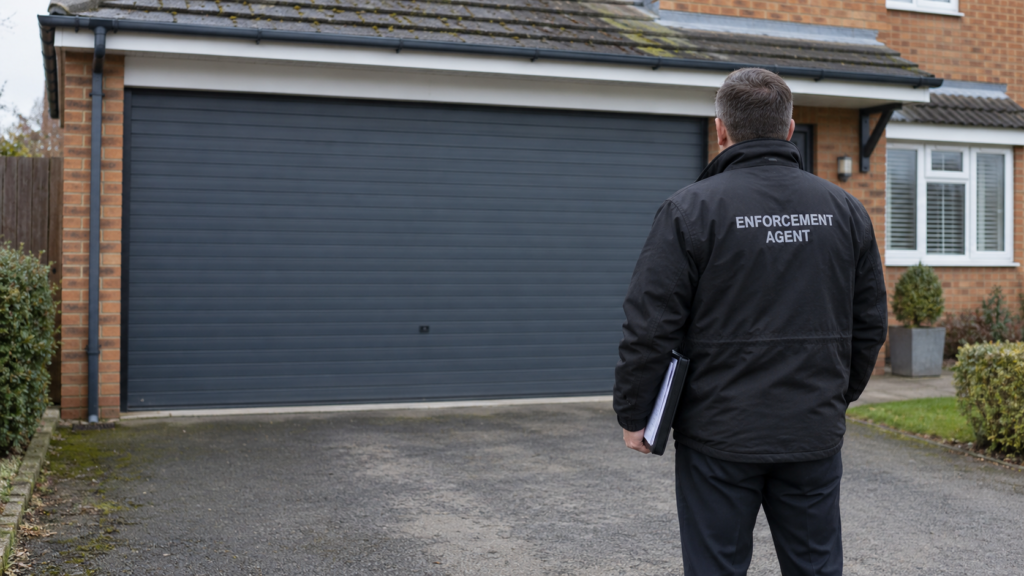
If bailiffs visit your home, you might assume that keeping valuables or a vehicle inside a locked garage means they cannot get to them.
For most ordinary residential enforcement, that is generally true if gaining access would require the enforcement agent to force entry — but there are important exceptions.
Whether a bailiff can enter a garage depends on factors including whether it is locked, whether it forms part of your home or business premises, what type of debt is being enforced, and whether the bailiff is returning for goods already taken into control.
Can Bailiffs Break Into a Locked Garage? (Quick Answer)
👉 For most ordinary debts, bailiffs cannot simply break into a locked residential garage on their first visit.
Government guidance says bailiffs normally cannot enter your home by force and generally have to gain entry through a door without forcing their way in.
However, the answer can be different if:
- the garage is unlocked and can be entered normally;
- the premises are used solely for a trade or business;
- the bailiff is enforcing certain debts for which greater entry powers exist;
- the bailiff has previously taken control of goods and has a lawful right to re-enter to inspect or remove them; or
- a court has specifically authorised entry using reasonable force.
So:
👉 A locked residential garage is not something an enforcement agent can ordinarily just break open because you owe a debt. But “bailiffs can never force entry into a garage” would also be incorrect.
Can bailiffs enter an unlocked garage?
👉 Potentially, yes.
You should not assume that a garage has the same protection simply because you have not invited the enforcement agent inside.
Government guidance on residential enforcement says that if nobody is present, an enforcement agent can enter where a door has been left unlocked.
Citizens Advice similarly recommends keeping doors locked because bailiffs can enter through unlocked doors.
This means leaving a garage unlocked could create a very different situation from an enforcement agent having to break a lock or force a garage door.
If you are expecting enforcement action, keeping external doors and accessible garages locked is therefore sensible.
Can bailiffs break the lock on a garage door?
👉 Usually not during an ordinary first visit to residential premises.
For most ordinary debts, bailiffs do not have a general power to smash locks, force open doors or otherwise break into your home simply because you have refused entry.
GOV.UK states:
“You usually do not have to open your door”
and says bailiffs cannot normally enter your home by force.
A locked garage therefore presents an important distinction: entering through an unlocked door is not the same thing as breaking a lock to gain access.
However, there are exceptions to the usual rule, particularly involving certain types of debt, business premises and lawful re-entry.
Can you hide your car in a garage to stop bailiffs taking it?
Keeping a vehicle in a locked garage can make it inaccessible during an ordinary visit where the enforcement agent has no right to force entry.
However, please remember that this does not make the underlying debt disappear, nor does it necessarily prevent future enforcement.
If the vehicle is one the enforcement agent is legally entitled to take control of, simply trying to conceal it indefinitely is not a good long-term solution to the underlying problem.
A better approach is to:
- establish whether the vehicle can legally be taken;
- check the debt and enforcement paperwork;
- contact the creditor or enforcement company;
- propose an affordable payment arrangement where appropriate; and
- get debt advice if you cannot resolve the situation.
What if the garage is attached to the house?
An attached residential garage should not be treated as an easy back door into your home.
For ordinary residential enforcement, the general restrictions on forced entry still matter.
If an enforcement agent can access an unlocked garage normally, however, the situation is different from having to break into it.
And if an internal door between the garage and house is locked, the fact that the bailiff has entered the garage does not automatically give them an unlimited right to force their way through locked doors into the rest of the home.
The precise circumstances matter, so if an enforcement agent claims they have a specific power to force entry, ask them what enforcement power they are relying on.
What if the garage is detached?
A detached garage does not automatically mean bailiffs are free to break into it.
The important questions include:
- whose premises it forms part of;
- whether it is residential or business premises;
- whether it is locked;
- what enforcement power is being exercised; and
- whether the agent has a separate right of forced entry or re-entry.
For an ordinary residential enforcement visit, you should not assume that a detached garage can simply be forced open.
Equally, don’t assume that leaving a detached garage unlocked prevents an enforcement agent from entering it.
Can bailiffs use a locksmith to open a garage?
👉 Not simply because you have refused to let them in.
A locksmith does not create a power of entry that the enforcement agent does not already have.
The relevant question is therefore:
Does the bailiff have the legal power to force entry in these circumstances?
If the answer is no, hiring a locksmith does not change that.
There are, however, circumstances in which reasonable force can be authorised. The Civil Procedure Rules expressly provide a process for an enforcement agent to apply for a warrant allowing reasonable force to enter premises where the statutory conditions are satisfied.
There are also different rules for certain debts and for some business premises.
Related guide: Can Bailiffs Use a Locksmith?
Can bailiffs break into a garage to take your car?
👉 Not if doing so would require unlawful forced entry.
A car can potentially be taken into control by an enforcement agent if it belongs to the debtor and is not otherwise exempt or protected.
But the fact that the bailiff could potentially take the vehicle does not automatically give them the right to break into somewhere they are not legally entitled to force entry into.
This distinction is important:
Can the bailiff take the car?
and
Can the bailiff legally force entry into this garage to reach the car?
are two separate questions.
If your vehicle is outside your home, GOV.UK specifically warns that a bailiff could take things even if you do not let them into the house.
That is one reason keeping a vehicle you own outright in a locked garage could matter during enforcement.
👉 Learn more about your rights with bailiffs and vehicles here: Can Bailiffs Take Your Car?
What if the garage is used for a business?
👉 This can substantially change the position.
The rules surrounding entry to business premises are different from ordinary entry into someone’s home.
Current GOV.UK guidance on warrants of control says:
“Agents may be able to break into business premises”
where there is no attached living accommodation and they believe the debtor’s goods are inside.
The Taking Control of Goods Regulations also specifically recognise premises used wholly or partly for a trade or business when setting rules for when enforcement agents can enter.
So if your “garage” is actually:
- a commercial workshop;
- business storage;
- a mechanic’s garage;
- an industrial unit; or
- another solely commercial premises,
do not rely on the ordinary rule about bailiffs forcing entry into someone’s home.
A domestic garage containing your lawnmower and family car is not necessarily treated in the same way as commercial premises used to operate a business.
Can bailiffs force entry for any type of debt?
👉 No. Forced-entry powers depend on what is being enforced and the circumstances.
For most ordinary debts, bailiffs cannot simply force their way into your home on an initial visit.
However, GOV.UK identifies exceptions involving enforcement of:
- unpaid criminal fines;
- Income Tax; and
- Stamp Duty,
where forced entry may be possible as a last resort.
There are also separate rules surrounding business premises and lawful re-entry.
This is why blanket statements such as:
“Bailiffs can never break in.”
or
“A warrant means bailiffs can break down your door.”
are both misleading.
The actual enforcement power matters.
What if the bailiff has already been inside?
This is another important exception.
The rules can change if an enforcement agent has already lawfully entered and taken control of goods.
The Taking Control of Goods Regulations specifically cover re-entry to inspect controlled goods or remove them for storage or sale.
GOV.UK also says an enforcement agent may be able to enter again where they have previously been allowed in and are returning to collect goods to be sold.
So you should not assume:
“I’ve locked the garage now, therefore they can never get the goods.”
If goods inside have already been formally taken into control, get advice on your particular circumstances rather than attempting to prevent lawful enforcement yourself.
Does a warrant mean bailiffs can break into your garage?
👉 Not automatically.
The word “warrant” does not itself mean an enforcement agent has unrestricted permission to break into every locked part of your property.
Different warrants and enforcement powers have different rules.
The Civil Procedure Rules even contain a specific procedure for an enforcement agent to apply for a warrant permitting reasonable force to enter premises in circumstances where the statutory conditions are satisfied.
That distinction is important.
If an enforcement agent tells you:
“I have a warrant, so I can break this garage open.”
you can ask them to identify:
- the debt being enforced;
- the enforcement power;
- the warrant or writ involved; and
- the basis on which they say forced entry is permitted.
Do not physically obstruct an enforcement agent, but equally don’t assume every claim about forced entry is automatically correct.
What to do if bailiffs are trying to enter your garage
If an enforcement agent is outside your property or says they intend to force open your garage, try to establish exactly what is happening before making decisions.
Step 1: Keep the garage locked
If the garage is already locked, you do not generally need to unlock it merely because an enforcement agent asks you to.
Citizens Advice specifically recommends keeping doors locked when dealing with bailiffs because unlocked doors can potentially provide a means of entry.
Do not physically fight, threaten or obstruct an enforcement agent.
Step 2: Check who the bailiff is
Ask for:
- their name;
- identification;
- the enforcement company;
- a telephone number;
- details of the debt; and
- a breakdown of the amount claimed.
GOV.UK says you can ask to see proof of identity and authorisation without letting the bailiff inside – for example, through a window or letterbox.
Certificated enforcement agents can also be checked using the official register.
Step 3: Find out what debt is being enforced
This matters because entry powers are not identical for every debt.
Establish whether the visit relates to:
- council tax;
- a parking debt;
- a County Court judgment;
- a High Court judgment;
- a criminal fine;
- tax debt; or
- another liability.
Do not assume rules you’ve read about one type of bailiff necessarily apply to another.
Step 4: Ask why they say they can force entry
If the enforcement agent threatens to break a lock or use a locksmith, ask:
“What legal power are you relying on to force entry into the garage?”
This is much more useful than getting into an argument about whether “bailiffs can break in”.
There are circumstances where forced entry is lawful, but they should be able to explain the basis for what they are proposing to do.
Step 5: Establish whether goods have already been taken into control
If the enforcement agent has visited previously, check whether goods inside the garage are subject to a controlled goods agreement or have otherwise already been taken into control.
Re-entry can involve different legal rules from an initial visit.
Step 6: Gather evidence if goods belong to someone else
Bailiffs generally cannot take goods that belong solely to somebody other than the debtor.
Useful evidence might include:
- receipts;
- invoices;
- finance agreements;
- bank statements;
- registration or purchase documents; and
- other credible evidence of ownership.
Don’t wait until a dispute is well advanced if you already know ownership is likely to be questioned.
Step 7: Contact the enforcement company or creditor
If there is a genuine dispute about the debt, ownership of goods or the enforcement agent’s powers, contact the enforcement company and, where appropriate, the creditor.
Keep copies of relevant correspondence.
Step 8: Get independent debt advice
If an enforcement agent is threatening forced entry and you’re unsure whether they have the right to do so, get advice quickly.
Free help is available from organisations including:
This is particularly important where the case involves criminal fines, tax debts, business premises or re-entry for controlled goods, because the ordinary rules about residential visits may not apply.
What if the bailiff breaks into the garage without the right to do so?
If you believe an enforcement agent has forced entry when they had no legal power to do so, document what happened.
Where possible, record:
- the date and time;
- the enforcement agent’s name;
- the company;
- what they said;
- what was damaged;
- photographs or video of damage;
- details of witnesses; and
- copies of notices or paperwork.
GOV.UK says you can complain where a bailiff:
“try to break into your home without a warrant”
and explains the appropriate complaint routes.
Depending on the circumstances, you may need specialist advice about challenging the enforcement action or recovering losses.
Realistic Examples
Example 1: Locked domestic garage
Tom owes council tax and an enforcement agent visits his home for the first time.
His car is inside his locked residential garage.
The enforcement agent asks Tom to open the garage, but Tom refuses.
👉 The agent does not ordinarily gain a general right to break the garage lock simply because Tom refuses to open it.
The enforcement agent may continue pursuing the debt through lawful enforcement methods.
Example 2: Garage door left unlocked
Rachel is expecting an enforcement visit.
Her detached garage door is unlocked and contains goods belonging to her.
👉 An unlocked means of access can create a different situation from an enforcement agent having to force a lock.
Keeping external doors locked is sensible when enforcement action is expected.
Example 3: Commercial workshop
James operates a vehicle-repair business from commercial premises containing tools and equipment belonging to his business.
An enforcement agent attends to enforce an appropriate debt.
👉 James should not assume the residential forced-entry rules protect his commercial premises in the same way.
Business premises can be subject to different entry powers.
Example 4: Goods already taken into control
An enforcement agent previously entered Priya’s property lawfully and took control of specified goods.
The agent later returns to remove those controlled goods.
👉 This is not necessarily governed by the same rules as an enforcement agent trying to enter for the first time.
Re-entry for controlled goods has its own legal framework.
Common myths about bailiffs and garages
Myth: Bailiffs can break into any garage
❌ False.
Bailiffs do not have a universal right to force open a locked residential garage.
Myth: A locked garage means bailiffs can never get your car
❌ False.
Different rules can apply to business premises, certain debts and lawful re-entry. The vehicle itself may also remain liable to enforcement if it is later accessible.
Myth: If a bailiff has a warrant, they can break every lock
❌ False.
The relevant enforcement power and circumstances determine what entry is permitted.
Myth: A locksmith gives a bailiff permission to break in
❌ False.
A locksmith does not create a legal power of entry. The enforcement agent must already have lawful authority to use forced entry.
Myth: Bailiffs can take anything they find in your garage
❌ False.
They cannot generally take goods belonging solely to somebody else, and certain categories of goods are protected.
Key Takeaway
👉 For most ordinary debts, bailiffs cannot simply break into a locked residential garage on their first visit.
However, the position can be different where:
- the garage is unlocked;
- it is a business premises;
- certain debts with greater entry powers are being enforced;
- goods have already been taken into control and the agent is lawfully re-entering; or
- appropriate authority for reasonable forced entry has been obtained.
If an enforcement agent threatens to break open your garage, don’t physically obstruct them.
Instead:
- keep the property secure;
- verify their identity;
- establish what debt they are enforcing;
- ask what power they rely on for forced entry;
- check whether goods have previously been taken into control;
- gather proof of ownership for third-party goods; and
- seek independent advice if the position is unclear.
The crucial question is not simply “Can bailiffs break into garages?”
It is:
👉 “What legal power does this enforcement agent have to enter this particular garage for this particular debt?”
Frequently Asked Questions
Can bailiffs break into a locked garage?
Usually not during an ordinary first visit to residential premises. However, exceptions can apply depending on the debt, premises, previous enforcement action and any authority permitting forced entry.
Can bailiffs enter an unlocked garage?
Potentially. An unlocked door can provide a means of entry in circumstances where forcing a locked door would not be permitted.
Can bailiffs use a locksmith on my garage?
Only where they have a legal power allowing the relevant forced entry. Hiring a locksmith does not itself give a bailiff additional legal powers.
Can bailiffs break into a garage to take a car?
They do not ordinarily gain a right to force entry into a locked residential garage merely because an eligible vehicle is inside. Different rules can apply in exceptional circumstances.
Can bailiffs break into business premises?
In some circumstances, yes. GOV.UK states that enforcement agents may be able to break into business premises where there is no living accommodation attached and they believe the debtor’s goods are inside.
Can bailiffs force entry if they have already visited?
Potentially. There are separate rules concerning lawful re-entry to inspect or remove goods that have already been taken into control.
Should I open my garage if a bailiff asks me to?
You do not ordinarily have to unlock a residential garage simply because an enforcement agent asks you to. However, if they claim a legal right to force entry or re-enter, get advice on the specific circumstances rather than physically obstructing them.
Need further support?
If you’re dealing with bailiffs and are unsure about their right to enter your property, free help is available from:
- Citizens Advice – free advice on bailiffs, debt and consumer problems.
- National Debtline – free, independent debt advice by phone and online.
- StepChange – free debt advice and help with suitable debt solutions.
- MoneyHelper – free, impartial UK guidance on money and debt.
If an enforcement agent is at your property now and is threatening forced entry, tell the adviser what debt is being enforced and whether the bailiff has visited or entered before, as those facts can materially affect the advice.
Related Guides
Sources and Further Reading
- GOV.UK — Bailiff powers when they visit your home
- GOV.UK — Apply for a warrant of control: enforcement agents’ powers
- Citizens Advice — Stopping bailiffs at your door
- Civil Procedure Rules Part 84 — Enforcement by taking control of goods
- Taking Control of Goods Regulations 2013
- GOV.UK — How to complain about a bailiff
This guide provides general information about enforcement in England and Wales and should not be treated as legal advice. Different enforcement systems and terminology apply in Scotland and Northern Ireland.